RPG Maker Save Editor
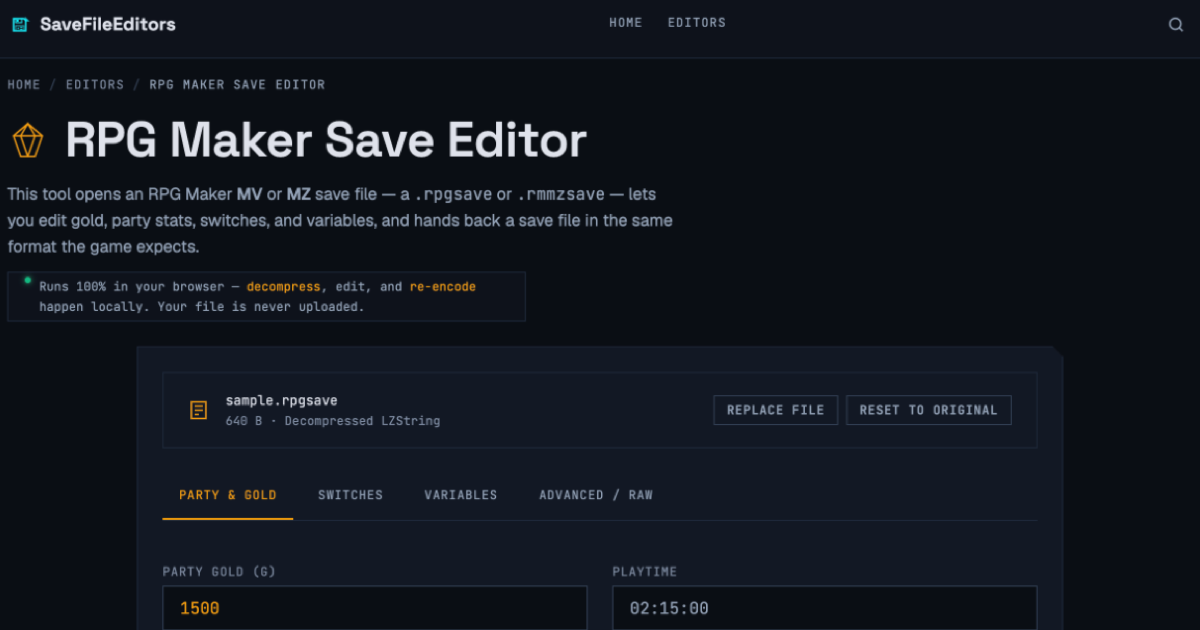
This tool opens an RPG Maker MV or MZ save file — a .rpgsave or .rmmzsave — lets you edit gold, party stats, switches, and variables, and hands back a save file in the same format the game expects.
Runs 100% in your browser — decompress, edit, and re-encode happen locally. Your file is never uploaded.
Keep a copy of your original save file somewhere safe before editing. This tool can't undo changes to the game itself.
Supports RPG Maker MV & MZ save files (.rpgsave, .rmmzsave). Parsing happens locally in your browser — nothing is uploaded.
.rpgsave (MV) .rmmzsave (MZ) file1.rpgsave LZString (MV) or zlib (MZ) formatDecompressing and decoding your save…
Edit Your Save File
—
Party Members
Full decoded save tree, including RPG Maker's internal @c / @ / @r metadata. Edits here go through the exact same validation as the friendly editor above: nothing downloads unless it round-trips cleanly.
How RPG Maker Saves Actually Work
The part most save editors skip explaining. It's also the reason a naive one can quietly break your file.
RPG Maker doesn't write your save as plain, readable JSON. Two things happen to the data first, and skipping either one is how a save gets quietly corrupted:
- It's compressed — and MV and MZ don't even use the same compression. Before anything touches disk, MV runs the save data through LZString and writes it as base64 text, which is why opening a
.rpgsavefile in a text editor shows a wall of characters instead of anything readable. MZ switched to raw zlib-deflated binary instead — a genuinely different format, not just a renamed one, and one plenty of editors built against MV alone get wrong. This tool checks the file's own bytes to tell which one it's looking at, reverses whichever compression it actually finds, edits the readable data underneath, then recompresses it the same way before handing the file back. - It's built from linked objects, not flat data. Once decompressed, the save isn't a flat object where your gold total just sits there in isolation — it's built from RPG Maker's own object format, JsonEx, which tags every class instance with metadata (a
@ckey for the class name, an@key for a unique id) so objects can point at each other instead of each holding a separate copy. That's how the party's actor list and an individual actor's own status data stay in sync: they're the same object referenced from two places in the save tree, not two copies of the same information. - Why a generic JSON editor gets this wrong. Say a tool just parses standard JSON, edits a value, and writes the result back with a plain
JSON.stringify(). Standard JSON has no idea what@c/@metadata means, so it serializes that shared reference as an ordinary nested object, duplicating it instead of preserving the link. If that link was how the party's actor list knew a specific character belonged to it, the game either fails to find them and crashes on load, or loads fine but treats the character as no longer in the party — even though every field still looks correct if you read the raw JSON by eye. - What this tool does differently. It never rebuilds that metadata in the first place: the original
@c/@/@rstructure stays exactly as the game wrote it, and only the leaf values you actually change get touched.
How to Use the RPG Maker Save Editor
Where your save file actually lives depends on whether your game runs on RPG Maker MV or MZ, and whether it's installed or browser-hosted.
Find your save file
For a locally installed game, MV saves are usually fileN.rpgsave inside the game's own www/save/ folder. MZ moved save storage to your OS's per-user app-data folder instead, so you're more likely looking for fileN.rmmzsave outside the game folder entirely. If the game runs in a browser instead of being installed, there's no folder to check: its save lives in that page's localStorage, and the FAQ below covers exporting it to a file first.
Load it into the tool
Drag the file into the panel above, or click it to browse. It's decoded in a background thread so the page doesn't freeze, and a file that isn't actually an RPG Maker save produces a specific error instead of stalling silently.
Make your edit
As a concrete example: to give your lead character 9999 gold before a boss fight, stay on the Party & Gold tab, find the Gold field near the top, and replace the number with 9999. The field only accepts digits, so there's no way to accidentally leave it in a state the game can't parse.
Download the result
Click Download Edited Save. Before the file downloads, your edit is re-encoded, decompressed a second time, and checked against the structure a real save should have. If that check fails, the download stays blocked instead of handing you a broken file.
Keep the backup until it's confirmed working
Load the downloaded file in the game before deleting or overwriting the original. If it looks right, replace the original with confidence; if something's off, you still have the file you started with.
What You Can Edit
This reflects exactly what the tool above exposes across its tabs, nothing more and nothing hidden in a tab you haven't opened yet.
| Category | What it actually controls | Example |
|---|---|---|
| Party & Actors | Level, current HP, and current MP for whichever actors are in your save's party (not equipment or skill trees, just the stat fields exposed per actor). | Fix an actor stuck at 0 HP after a plugin bug instead of replaying to grind them back to full. |
| Gold | The party's shared currency total, read from and written back to the same field the in-game menu displays. | Set gold to whatever you need before a shop run or a boss fight that calls for upgraded gear. |
| Switches | RPG Maker's global on/off flags, referenced by index number, that events check before deciding what's allowed to happen. | Often used for things like whether a locked door has been opened or a cutscene has already played. |
| Variables | Numbered slots holding arbitrary numbers, used by events for counters and thresholds that need more than on/off. | A variable tracking something like reputation points or chapters completed that gates later content. |
| Playtime | The total-hours-played counter shown on the game's own load screen. | Displayed next to Gold for reference — this tool doesn't let you edit it, so treat it as read-only here. |
Frequently Asked Questions
Safety, file locations, and what to do if something looks wrong.
Only if you skip the backup step first. The tool itself won't corrupt a valid save: it doesn't touch your original file at all until you click Download, and before that download unlocks, the edited data is re-encoded, decompressed a second time, and checked against the shape a real save should have. If that check fails, you get a specific error instead of a broken file.
For a locally installed game, look in www/save/ inside the game's own folder; MV saves are usually named file1.rpgsave, file2.rpgsave, and so on. MZ moved save storage to your operating system's per-user app-data folder instead (on Windows, typically %LOCALAPPDATA%\<Game Title>\Save\), so an MZ save is more often named file1.rmmzsave and won't be sitting next to the game's executable. If the game runs in a browser instead of being installed, there's no file to browse to — see the next question.
This tool only reads files, on purpose. Reading another site's localStorage from here isn't something a browser allows. Open your browser's developer console on the page the game runs on, find the save key with Object.keys(localStorage), then run copy(localStorage.getItem('the-key-name')) to copy the raw save string to your clipboard. Paste that into a plain text file, name it with a .rpgsave extension, and upload it here. The content is identical to what a file-based deployment would have written.
Not directly, and it's worth explaining why: this tool needs a save file you can select through a normal file picker, and a mobile export (wrapped for Android through Cordova or something similar) keeps its save data inside the app's own private storage, which a regular file manager can't reach without a rooted device. If you're able to pull the raw save data off the device yourself, the format underneath is the same JsonEx-based format this tool already reads (LZString-compressed for MV, zlib-compressed for MZ), so it should still open here once you have the actual file.
Try the original backup first. If that also fails, the problem predates this tool. If only the edited file fails, the most likely cause is a value RPG Maker's own UI wasn't built to display sensibly (gold with far more digits than its window expects, for example), not a corrupted file, since this tool blocks the download if the file itself is structurally broken. Try nudging the value back toward a plausible range and downloading again.
No. Some online save editors work by uploading your file to a server and deleting it later, often within a day; this one never uploads it at all. Decompression, editing, and re-encoding all happen in your browser's own memory using JavaScript running on your machine. You can check this yourself: open your browser's developer tools, watch the Network tab while you use the tool, and you'll see your save file never leaves the page.
No — that's a genuinely different format, not just an older version of this one. XP, VX, and VX Ace save as .rxdata using Ruby's own Marshal serialization, while MV and MZ save as .rpgsave/.rmmzsave using the same JsonEx object format this tool actually reads (compressed with LZString on MV, zlib on MZ). The similar-sounding names don't mean similar formats underneath, so a .rxdata file won't open here. If XP/VX/VX Ace support matters to you, the Contact page is the way to ask for it.
Other Save Editors
More engines are on the way; each gets its own dedicated tool, not a reskinned copy of this one.
.json
Generic JSON Save Editor
A catch-all visual editor for any game that stores its save as readable JSON.
.dat / registry
Unity Save Editor
Inspect and edit Unity PlayerPrefs and binary serialized save data.